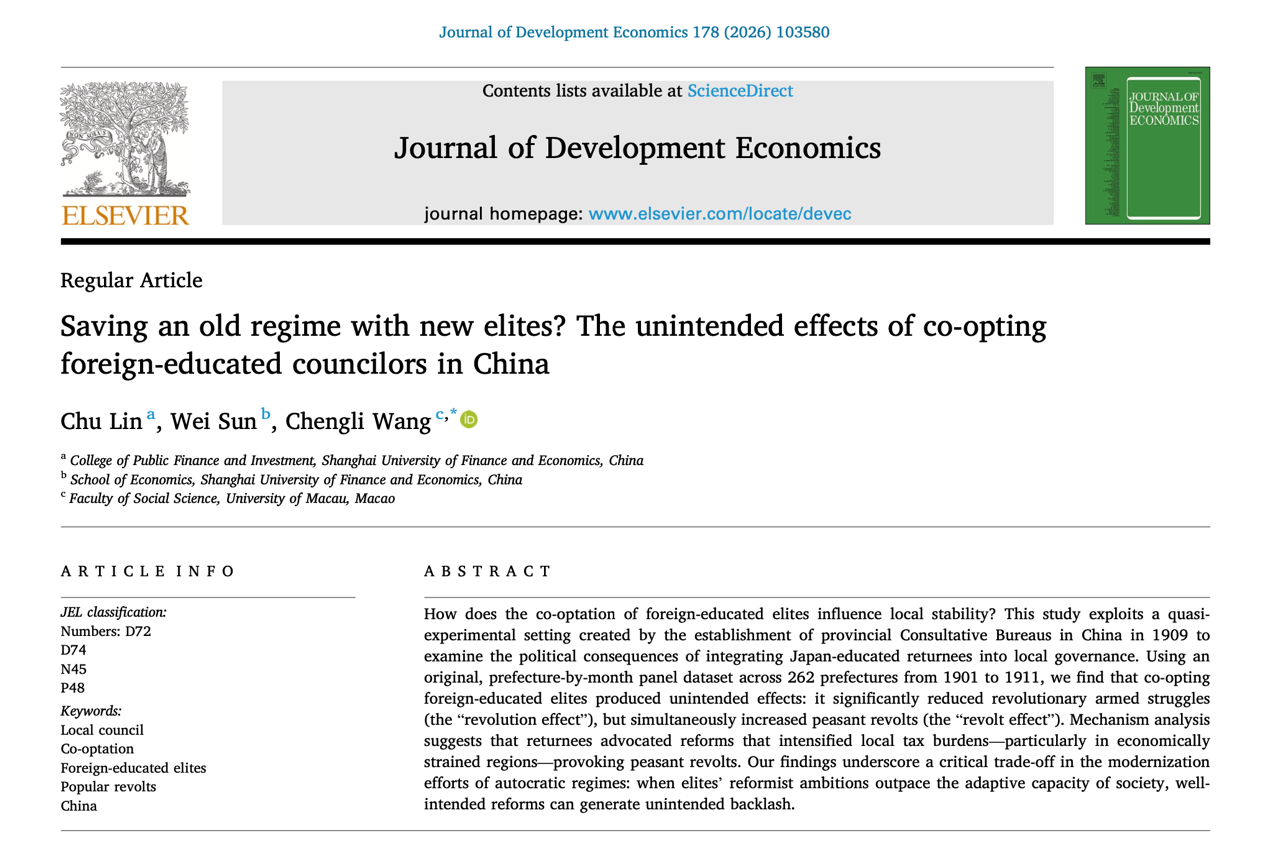
近日,上海财经大学经济学院资源与环境经济学系孙韦副教授合作论文Saving an old regime with new elites? The unintended effects of co-opting foreign-educated councilors in China在经济学国际一类期刊Journal of Development Economics发表。

How does the co-optation of foreign-educated elites influence local stability? This study exploits a quasi-experimental setting created by the establishment of provincial Consultative Bureaus in China in 1909 to examine the political consequences of integrating Japan-educated returnees into local governance. Using an original, prefecture-by-month panel dataset across 262 prefectures from 1901 to 1911, we find that co-opting foreign-educated elites produced unintended effects: it significantly reduced revolutionary armed struggles (the “revolution effect”), but simultaneously increased peasant revolts (the “revolt effect”). Mechanism analysis suggests that returnees advocated reforms that intensified local tax burdens—particularly in economically strained regions—provoking peasant revolts. Our findings underscore a critical trade-off in the modernization efforts of autocratic regimes: when elites’ reformist ambitions outpace the adaptive capacity of society, well-intended reforms can generate unintended backlash.
孙韦,上海财经大学经济学院副教授。主要研究方向为环境经济学、发展经济学、应用微观经济学。相关研究成果发表于Journal of Development Economics、Journal of Environmental Economics and Management、Journal of the Association of Environmental and Resource Economists、Journal of Regulatory Economics等学术期刊。
供稿、供图|孙韦
编辑|杜雨晴
审核|燕红忠