相关链接:http://english.cntv.cn/2016/09/13/VIDE6YAhQaoFVlECIq9Q2vY1160913.shtml
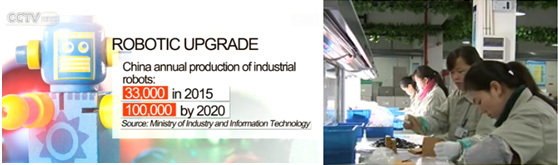
Q1: More and more industries are replacing manual manufacturing with innovative technology, how could the Chinese government balance between continuing to upgrade industries and ensuring employment rate?
Whether the government should have industrial policies, or at least that significant amount of industrial polices, is a contentious subject in both the academic circles and policymaking groups. The supporting side argues that there are industries related to national defence and crucial future trends. While not necessarily totally disagreeing that national defence is a necessity, the liberalists argue that the government is not as good as business persons in deciding the next big wave of innovation, and the power to choose which industry to support invites rent seeking opportunities.
If we agree more with the liberal view, there is less to care about the tradeoff, we then could focus more on the people who lose their jobs due to the creative destruction. But perhaps, even that we could let the market does the work. The market is able to heal itself in impressive ways. Take the freest economy, which is Hong Kong, as an example. In the last 180 years. It transited from a fishing village, to a production centre that produced plastic, clothes, wigs, watches, to a world financial hub that enjoys world reputation. Each phase was transited perfectly while maintaining the world's lowest unemployment rates and fastest growth.
During the Zhurongji's era, China managed to sack tens of millions of SOE workers and yet there were not many massive protest as the unemployed were quickly absorbed into different industries harnessing the power of the markets just started to open.
Q2: In which industries are human production and manual manufacturing irreplaceable?
In terms of education for labor force, what role should the government play in the future?
The boundary is already getting blurred about what machines cannot do, especially in light of the highly acclaimed Stanford's report entitled "Artificial Intelligence and Life in 2030" just released
The government should provide a good basic training for free and then let the poor have a good enough opportunity to study and work hard to climb the social ladder. After all, a large part of the world finally belongs to the poor who work the hardest. The government should remove most barriers, such as the now less relevant hukou system that was established due to historic reasons, so workers could flow freely across jobs and cities where they find themselves most valuable.
The government should provide a very basic welfare system, well the ones that won't easily inflate into a full-fledged welfare system. We need that to save people when they are unemployed so they have the courage to transit into a new job.
In short, embrace changes, increase mobility and basic education, and provide the least acceptable measures to give people time and food to survive the transition, and then let the market plays it role of matching the employers and employees.
|