视频相关链接:http://english.cntv.cn/2016/08/18/VIDE4KHxQ5aCGN8xp9pMMJfO160818.shtml
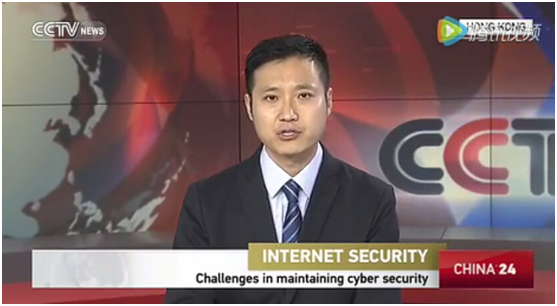
Q1 Major challenges China is facing in maintaining and enhancing Internet security.
A1:Challenges include the balance between top-down and bottom-up approaches, as well as international collaboration. Cybersecurity is necessarily an arms race. There does not seem to be a permanent winning party. The damages are at times all or nothing because one single weak link of the whole system could provide an attack point that affects millions. With this spillover effect, one has an incentive to shirk as one could free-ride. This calls for the participation of the government to provide what the market participants cannot coordinate themselves to provide.
In this regard, the Chinese government has established the China network security and IT leadership team in 2014. The team is tasked with national security and long-term development and co-ordination of major issues related to network security and IT. The team also studies laws to enhance national security capabilities.
Questions like what actions are ethical or legal are very important. For example, there are "black, white and grey hats" among the hackers. Some hackers believe that exposing security problems, even with enough information to exploit the holes, is ethically correct and anything less is irresponsible. Other hackers believe that giving enough information to exploit the problem is wrong. They believe that problems should be disclosed to the software vendor ONLY and that anything more is irresponsible. This is but one example that calls for a more clear legal protection of individual rights so we could harness better the power of the market. Fear alone might stop hackers from contributing to the common good.
Lastly, mistrust hinders international collaboration. We have yet to coordinate better among nations to solve problems together.
Q2. Any international cooperation between China and other countries to crack down on cyber crime? For instance, sharing info about attackers or the virus database?
A2:Yes, in 2011, the United States and China committed for the first time at head of state level to work together on a bilateral basis on issues of cybersecurity. Fighting spam was the first effort to help overcome the trust deficit between China and the United States on cybersecurity. In 2009, China was ranked No.3 spam-producing country in the world, but now China is ranked No.20. Also, there are already databases for publicly known information-security vulnerabilities and exposures which anyone could access and contribute.
Besides, the International Multilateral Partnership Against Cyber Threats, nicknamed IMPACT is the first United Nations-backed cybersecurity alliance that was established in 2011. IMPACT serves as a politically neutral global platform that brings together 152 governments, and partners from the industry and academia to fight cyber threats. IMPACT is the largest cybersecurity alliance of its kind.
There are also a handful of other global agencies that either serve a particular group of nations or problems.
|