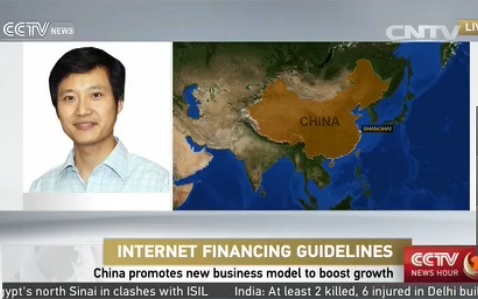
采访视频链接:http://english.cntv.cn/2015/07/19/VIDE1437281280592147.shtml
1. What is the meaning and use of such guidelines? The guidelines provide measures to promote innovation in Internet finance, including boosting cooperation between financial institutions and Internet companies, expanding access to capital, cutting bureaucratic red tape and introducing tax breaks. The more specific central messages are: First, the government endorses the Internet finance business, welcomes to see more innovation there. Second, it provides a classification for various areas in Internet finance, and is sending a signal that these areas are not just e-commerce but finance in nature, and thus it is justified to regulate systematic finance risks that may arise there. A senior central bank researcher said last month that regulators should allow banks to set up online finance subsidiaries to fend off rising competition from technology giants that have expanded into their territory. Third, it delineates which areas should be under the governance of what governmental bodies. Namely, the central bank will oversee online payments, the securities regulator will be responsible for crowdfunding and online sales of funds, the banking regulator will supervise platforms that directly link borrowers and lenders known as peer-to-peer lending, the China Insurance Regulatory Commission will oversee online insurance while MIIT oversees the website registration process. The reaction from the group of Chinese professional economists seems to be mixed. On one hand, e-commerce is an area with relatively fewer government regulators and that has been attributed to its phenomenal growth. On the other hand, worries have been voiced that rent-seeking opportunities are thus institutionalised because it is now more clear which officials should a businessman go to for green lights. The key then is whether these guidelines could be enforced in a clean manner with little corruption. 2. What does it mean for small enterprises for this guideline? There are two sides of a coin. The situation in the last few years was that China regulated Internet finance much much more loosely than what other developed countries did. For the group of small enterprises that wanted to open the Internet finance business, it could be bad news as there are now more barriers in some aspects as the regulators now want to see "qualified" firms entering the market. Though it will be good if you are a rising star who operate your business properly if the market turns out to be more efficient. It will also be good for the group of small enterprises that are the customers of Internet Finance; these guidelines could be excellent news. Look, the new private Internet banks this year by Alibaba and Tencent already provided an array of lending opportunities for small business requiring only collaterals such as social media presence but not those required by traditional banks. I expect to see more and more innovation for those customers. 3. What are the future implications for the real economy and challenges? I have been working on the e-commerce area for twenty years. A lot of so-called today's innovation such as P2P lending and O2O today were already germinated from that time. It is, among other things, the advance in Internet finance technology especially mobile online payment and improved security that allow these innovations to come into light. The most promising catalyst for the economy I would say is the use of big data to further fine tune a national credit system so that people could borrow money at the right interest rates that match with their risks. The challenges are always security as it is an arms-race and our offline world will only be overlapping with the online world more and more. Regulators should also look into better laws that catch up with the pace of Internet advances. |