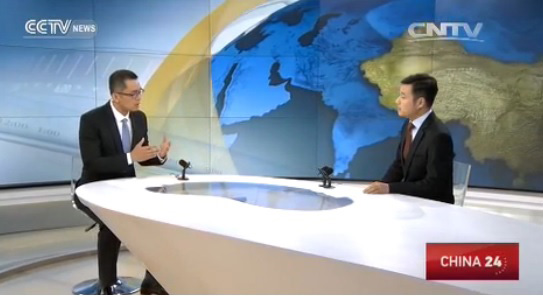
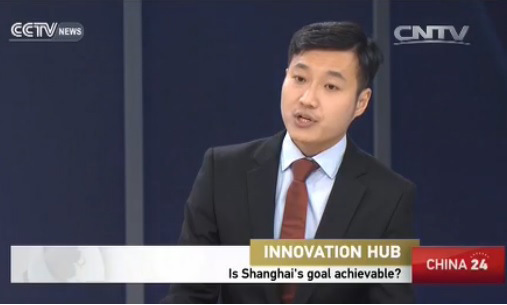
采访视频链接:
1、You are from Hong Kong. When you first arrived in Shanghai, do you think the procedures bothersome? That was an interesting experience. By the time I finished with all the procedures I had traveled half of Shanghai. It would help if there was one central office that would take care of every government document related to settling in. 2、As a professor, how do you like the policies that encourage faculties to become entrepreneurs? A dozen professors in each major university will become multi-millionaires overnight if proper innovation policies are in place. This new set of policies is moving a big step towards this. I visited several science parks in Shanghai in the last few days. In fact, I am just closing on deals about bringing tens of millions to universities. I lived right by Fudan University, Shanghai U of Finance and Economics and Tongji University. I feel that recently the sensation of innovation is burning in the air especially among the young people. As a professor, you could now more formally take a part-time job outside in innovation firms. You could also suspend your job for a few years without leaving the job. Also, researchers are allowed to retain a larger share of profits from their innovation at school. For students, the new policies allow them to take a leave from school to open their businesses and come back to school a few years later. This is very important. It provides cushion for failures. It gives people a fall-back option if they fail. If you do not fail enough, you are not making enough innovation. Billionaires in the Silicon Valleys are sometimes university dropouts. Lastly, the new policies help a lot in circumventing the rigid education system in China. The new policies allow that students to take credits for participating entrepreneurship programs. Firms and universities are empowered to co-educate the kids together.
I will talk about people, space, and history. First, people. Shanghai is the most business friendly city with the cleanest officials in China. The new policies further reduce rent-seeking behavior. The policies more clearly delineate what is not on the list should NOT be regulated. There has been a saying that Shanghai officials do not take enough risks. Oftentimes they reward innovation ex post but not ex ante. An optimal reward system should be icing of the cake as well as timely assistance. Close to half of Shanghai’s population, about 10 million of them, migrated to Shanghai in the last 10 years. The finance industry there is so profitable that the best brains go to this industry but not innovation. The new policies loosen up migration policies further for high-skill labors and direct people to innovation by giving them hukou, their permanent permit to stay, if they have secured venture capital. Second, space. There are not enough coffee shops in Shanghai’s science parks. It looks like there are too many high-rises there unlike the lively scenes in Beijing, where old housing surrounds Zhongguancun where young innovators could find affordable housing. Third, history. Shanghai is not as innovative as it once was in 1920s-30s. If you look at two pieces of crucial statistics, Shanghai is way below other cities. Of the top 500 private firms in China, there are ten times more of those in Zhejiang providence than in Shanghai, and 6 times more in Jiangsu, and two times more in Guangdong. For trademarks, there are 4 times more new trademarks registered in Guangdong than in Shanghai. Why? Obviously, land prices play a big role. Being the most expensive city in China, Shanghai people had already been satisfied investing for capital gains in the property markets. Another important reason that has not been given enough attention is the predominance of state-owned enterprises. In the 1990’s, Premier Zhu Rongji managed to induce massive layoffs through moving SOEs to the countryside and use the land proceeds to pay for early retirement. The Shanghai officials, however, did a good job in reducing massive layoffs but a lot of SOEs remain. In the city center, for example, there are still quite a few unproductive SOEs. If you think deeply about why the Internet business flourishes in China, you might notice that it is the one major industry with no SOEs there. 4、Do you think Shanghai’s goal is approachable based on the draft plan? Yes and no. Shanghai is a big magnet. Pudong was built in 10 years and it looks like Manhattan to me. Shanghai has the best infrastructure you need in China to achieve the goals. The parts I am unsure are two. First the policies did not explicitly mention about standards. The very important fact is that product market is not only driven by innovation. It is also driven by something that kills innovation, i.e., standards. A technology is being adopted not only because it is high tech, it is also because many people are using it. The new set of policies did not address how Shanghai is going to play a dominant role in influencing standards setting in international organizations. Second, the goal is still a bit vague to me. It did not provide enough metrics for evaluation. While the government explains the intent of the new policies, it does not adequately address what metrics will be used to evaluate these policies and officials. By introducing new metrics midway, the policies could be implemented differently to fit the evaluation rules. |