采访视频链接:
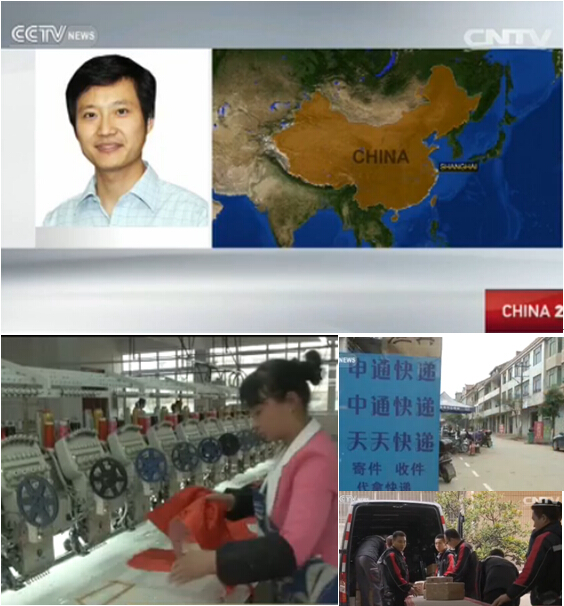
For more, joining us on the phone now is Professor Benjamin Chiao, Assistant Dean at Shanghai University of Finance and Economics. Hi, Benjamin. Q1: Promoting E-commerce at rural areas... How will this impact the rural life and development? The household registration system has been prohibiting the free migration of the rural people to the cities. The rural people wanted to move out because people in the city make more money. The original intention several decades ago was to make sure that the people in the city especially those working for SOEs to earn enough money so the heavy industry could prosper, the national defense could be strengthened. We have less of a need to distort the economy this way because we are stronger now in defense and have enough capital and industry base so resources could be devoted to the agriculture, light industry and heavy industry at the same time. Yet young rural people continue to want to migrate and work in big cities. The reality is housing prices and cost of living force them to live somewhat miserable lifes in the cities. The good news is the Internet dramatically shorten the distance between resources, markets and people. As long as other resources especially higher institutes start to move away from the cities, rural people should live a better way than city people in many senses: larger houses, cleaner air, and closer to parents. Do it the right way, the Internet will keep the right amount of young people in the rural area. Q2: On the other hand, what are the challenges and obstacles on the promotion process? Neither the top-down or bottom-up approach alone could complete the process. Disintermediation allows the farmers to directly face the customers in the city. In fact, some data coverage in China's rural areas is even better than those in the States. However, the oligopoly market in telecommunication is not giving these individual farmers a plan flexible and cheap enough to lure them into eBusiness. I have seen, however, cases in which farmers form cooperatives inside the villages to operate their websites and send packages to customers. A big problem is that customers still have little confidence about the claims of the farmers. Indeed, This is a time the farmers enjoy the late-mover's advantage. Using a 500RMB phone one can operate an eBusiness.It is not wise to transfer the technologies from third-tier cities to villages. We should carefully select the future generation of technology, make it more secure and apply there. I know that the 2008 Wenchuan Earthquake completely wiped out the infrastructure there. Now we see the world's most advanced health IT systems already installed there. Lastly, farmers have little to back up their investment. The government should allow more flexible collateral schemes for farmers's finance needs. |