采访视频链接:http://english.cntv.cn/2015/02/14/VIDE1423890482087721.shtml
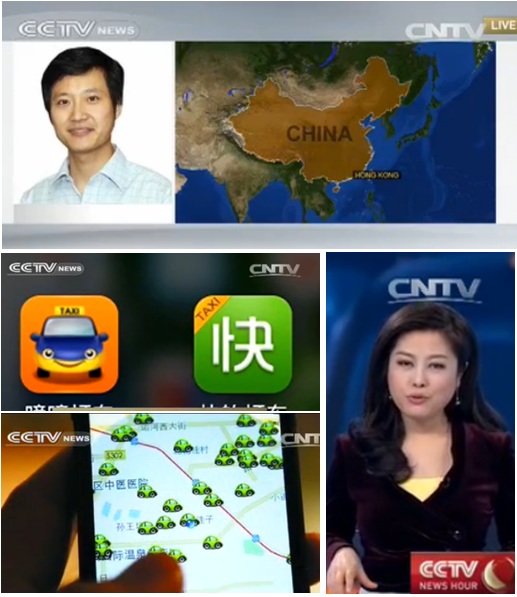
For more insight, we're joined on phone by Professor Benjamin Chiao, Assistant Dean of Institute for Advanced Research at Shanghai University of Finance and Economics. Q2 What are the effects on the whole industry? First, this would further reinforce Uber’s strategy to leverage on existing platform. Baidu would help a lot. Baidu’s mobile search service has more than 500 million monthly active users, while its Baidu Map service has 240 million. Indeed, car-hailing apps have leveraged on existing successful platforms. The Didi Dache had a huge boost from Tencent. Tencent’s WeChat users booked a total of 21 million cabs in the first month of the tie-up between WeChat and Did Dache. Didi Dache alone has more than 100 million registered users covering over 300 cities in China. Didi Dache together with Kuadi make up of almost the whole market in China. Uber covers only about 10 cities. But Uber is bringing innovations and experience accumulated worldwide to fight the battle. For example, Uber would provide customised services, even delivering a lion-dance team to your place during the Chinese New Year. Uber is being heavily sanctioned in many countries, China is without regulation on this as of now, so it is a huge market Uber must fight for. Second, users must worry about whether the merger will decrease the company's immediate incentives to continue to subsidise users and raise prices. This is far from conclusive at this stage because O2O market is yet to take more and more offline services online so building market share and attracting eyeballs could still be a dominant strategy now. So I don’t worry too much that the merger would bring higher prices in the near term. |