更多背景资料视频链接:
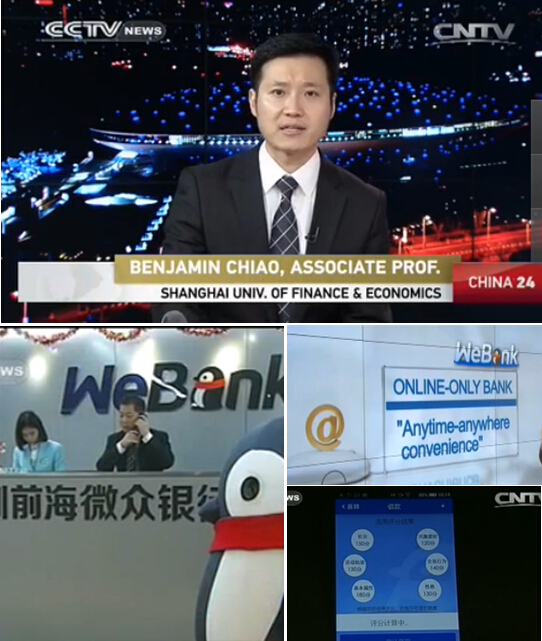
Q1. Currently, major state-owned banks have their own web clients and apps too. Services such as transfer and purchasing financial products can be done at home without extra fees. Many of them have already cooperated with electronic payment platforms to achieve multi-channel transactions. So for consumers, what attracts them to choose private online banks such as the Webank? What's Webank's advantages? WeBank is claiming to put all operations online so the first thing is you don’t need to queue up in state-owned banks. Also, individuals and micro-businesses feel simply too hard to get loans before. State-owned banks used to support our nation’s mission to develop heavy industries first; their priorities were not small customers and businesses. In China, about 30% of privately-owned property is purchased on credit and not even 20% for cars. Most Chinese borrow money from immediate family members. There has been a lot of rumors that WeBank will target on loans less than RMB 1 million. On the other hand, customers will enjoy better deposit rates too. Through interest rate deregulation, the upper bound on deposit rates will soon be relaxed. With a significant portion of profits taken out from the interest rate spread, banks need to find new ways to make money. WeBank will have an edge through the data collected from Tencent’s various online platforms. We are expected to see one of the most sophisticated customer profiling systems unveiling. Q2. The safety of assets is the most concerned problem for users. The more a bank supports small and medium-sized companies, the greater risk of bad loans it affords. So the question points to a credit rating system of borrowers. For private online banks, how do they use the mass data collected online to value their users? And as the bank is backed by private companies, how do these companies keep their normal operations so as to guarantee the safety of their users' assets? There is no direct linkage of bad loans and small loans. Some state-owned enterprises in China are only being kept alive by government. Worldwide, on average, private firms perform much better than state-owned enterprises. If WeBank uses their big data properly, they could further select the better cut of the small private borrowers. Your online purchase history, address, occupation, social ties are all significant components they might look into. Overall, is a private system a more risky banking system? Hard to say, as there is already a huge shadow banking system in China. It is time to remediate the situation. But according to international standards, private banks alone cannot provide a satisfactory solution. Policies need to be in place. State-owned banks are widely viewed as carrying a government bailout guarantee. To help private banks to compete for businesses, China revealed a new deposit insurance scheme last year intended to insure all deposits under RMB500,000. It makes sense for government to provide some level of risk reduction policies as risks could be spread simply through herd effects. More studies need to be conducted to draw a fine line between the risk-reduction responsibilities of the government and the private banks. |