更多背景资料视频链接:
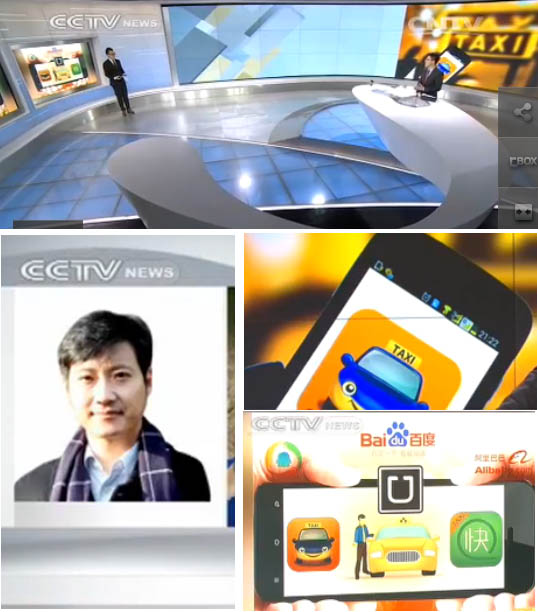
Let's bring in Benjamin Chiao, associate professor at the Shanghai University of Finance and Economics to get his thoughts on the ongoing tussle between private car taxi services and the traditional licensed drivers.. Q1: How do you think this tussle will eventually turn out? On the one hand, in cities like Beijing, official taxis cannot meet demand, so private taxi hailing apps do provide a necessary service...what do you think? Will policymakers here find a balanced solution? You are right. Major cities in China do not have a taxi service that adjusts to the demand and supply quickly. It is common to see taxi drivers to wait for several hours to pick up passengers from airports. It is also common to see passengers waiting for a cab for half an hour in a rainy day on a busy street corner. It is clear that because cab fares are rigidly controlled, it is overpriced sometimes and underpriced some of the times. By allowing the market to find the right price freely, private car taxi service will clear the market much more efficiently than traditional taxi service. There is a catch though. With freedom in pricing, customers would see price surges when demand is abnormally high. We have seen prices went up close to ten times during the New Year’s Eve in the States. It is not a bad thing because demand will be met promptly at high prices. However, sometimes it might be politically incorrect to allow price surges during times of disasters. Uber was forced to refund the surcharges gained during the latest terrorist episodes. I think this is what the regulators need to think about. So this is the price mechanism differences and now I will talk about the market differences. Kuadi and Didi, the two largest car-hailing apps in China controlled by Alibaba and Tencent, have each finished the new round of funding at more than US$5bill each. They are now offering premium service that targets medium to high-end passengers by matching passengers with somewhat luxurious cars. It is very much like the Uber’s Black Car service. Unfortunately, Uber has not yet been very successful yet in China. So one point to take is at least in the initial stage, the traditional taxi service will serve the lower end market while the medium and higher end market will be served more and more by these new private car taxi services.
The impact of traditional taxi market, I think, will be mostly seen as the breaking up of the monopoly of taxi management state own enterprises. Because there is already no room for salary cuts of the taxi drivers—this is a group of hardworking people who work 12-15 hours each shift a day making about 6000 or 7000RMB a month. During the early days of reform, taxi drivers were very lucrative occupation. We no longer see young people who are very willing to be a taxi driver now. I would expect that there will be strong resistance from existing taxi drivers for this private car service just like many other cities. France, for example, has banned Uber nationwide. But in the longer run, by moving into the new private car taxi service, these workers will make more money. I asked several drivers today, they all said they are making 30% more than they used to as taxi cab drivers. But there will always be protests going on, especially there is a vacuum of safety regulation. For example, if there is a criminal act going on in the private car, who should be liable? And if we run into an accident, are proper insurance paid for? Being private, we should expect some of the companies that will cut cost in aspects that are not easily observable for first-time customers. For example, yes you might enter a luxurious car but mid way you will find out the insurance policies do not match with the outlook of the car. Back to you. |