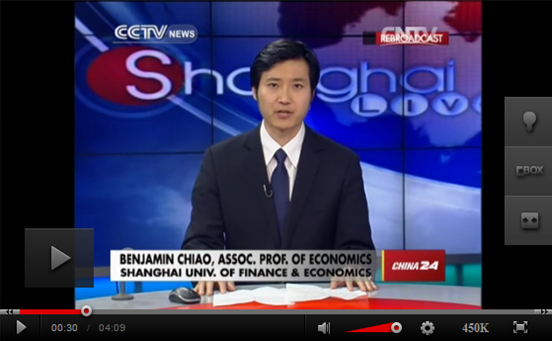
采访视频连接:http://english.cntv.cn/program/china24/20140212/100417.shtml
While 4G users in Beijing complain about the poor coverage, the eastern city of Hangzhou takes the lead in 4G coverage in China. Users can connect to the 4G network in most areas of the city including metro lines.
Q1:How would you describe the current 4G market? A1:China Mobile had dominated the 2G market. China Unicom and China Telecom are having a strong rebound in 3G making it a more equally shared market. However, in the 4G market, these two operators are in a much disadvantageous position--the winning operator so far is clearly China Mobile. Why? Because the Ministry of Industry and Information Technology needs to give them licenses of what standards and which frequency bands to use. The ministry has now issued only the TD-LTE license to all three operators, with China Mobile getting a disproportionately wide band of 130MHz while the other two getting only 40 MHz each. More, the development of TD-LTE is driven by China Mobile so its chain of operations are highly compatible with TD-LTE making it the first operator to provide 4G. The ministry has said it would sort of "make it up" by issuing a different type of license, the LTE-FDD license, "soon" to all three but China Mobile. The other two operators love LTE-FDD since this is the mainstream world standard with many suppliers of equipment to choose from and more compatible with the existing infrastructure of these two operators. That said, a more balanced position in the 4G market will largely depend on when the LTE-FDD license is issued. From the consumer's point of view, the more internationally available LTE-FDD could mean lower roaming charges and lower end device costs due to economies of scale. There are always two sides of a coin of course. China is the largest 4G market, large enough to nurture its own standard. For the very nature of network goods, even a potentially inferior technology could become a rational choice and dominant world standard as long as enough people are persuaded or forced to using it. How to speed up the transition from a world factory to an intellectual property powerhouse is an important question. Let alone there might be other national security issues.
A2:Whenever we hear questions of this type, it usually reflects a sentiment that there is not enough competition in the market so that prices are artificially fixed at an unreasonable level. Note, however, that sometimes people are using the wrong unit of measurement, comparing oranges with apples. An extreme form of payment plan available in many countries are the no limit data plan--you pay a fixed fee and you could download as many files as you want. Is it suitable for all stages of development? Probably not. 4G promises a maximum bandwidth but what you want is how much data you could download. It depends on how many people are using, say, the nearest transmission tower. If there are not enough towers, a cheap price would greatly increase congestion making everybody worse off. The good news is China is expected to have hundreds of cities equipped with 4G later this year. But even cities with excellent infrastructure like Hong Kong, there are still many 4G blind spots. Scientists are working hard to ease up congestion by setting the technology and incentives right. For example, some countries allow users to pay a fixed fee to use a certain limit of usage say 5GB, you will still be able to use the network beyond the limit but with a lower speed if there are more people around you. Lastly, 3G is still here, you pay for 4G when you think it worths it. |