采访视频连接:http://english.cntv.cn/program/china24/20131104/105039.shtml
Chinese biggest mobile telecom provider China Mobile is blaming instant-messaging apps such as Wechat for a sharp drop in profits. Full story >>
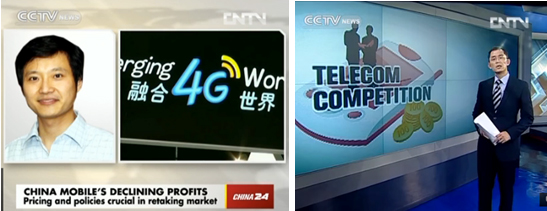
Joining us on the line now is Professor Benjamin Chiao, from Shanghai University of Finance and Economics.
Q1:Is the rise of instant messaging softwares like Wechat really to blame for the profit loss of China Mobile?
A1:I will focus on two things: Competition and Customer Base.The major competition of China Mobile are two. One is from other carriers. The second is from other OTTs. That said, the fall of China Mobile's profit could due to the first or second competition. Since OTTs affect all three carriers but only China Mobile is weakened on profits, there might be some China Mobile specific reasons. China Mobile is still the largest mobile operator but its share of 3G connection is not the largest. With that, the picture becomes more clear. Instead of making phone calls, users can substitute by communicating using WeChat. But users who use OTTs are likely to use 3G more: they want to send more pictures faster. In other words, OTTs are substitutes of 2G but complements of 3G.Companies like China Mobile whose revenue is predominantly dependent on 2G will suffer more.
The second factor is customer base. Expensive phones are excellent to screen out wealthy customers. Companies like to use the "Bargain-and-Rip-Off" strategy. Both China Unicom and China Telecom had annual net profits slide when they first signed with Apple. This is largely due to the high cost of subsidizing iPhone sales. China Telecom is expected to see a rebound of net profits while China Unicom has experienced a huge profit this year after trimming iPhone subsidies now that China Unicom has established its high-end user base. But China Mobile is already way behind on this.
Q2:Will 4G investment help China Mobile regain a share of the market?
A2:It is not uncommon to see a "slow-mover advantage" especially on infrastructure. Subway or trains in China are much better than those in the States. If China Mobile makes the right move, not just on 4G infrastructure but on pricing and other policies, it could regain its market if other carriers get stuck on policies and infrastructure that are too fine-tuned for 3G users.
Note also that the threat of OTTs is not just about WeChat substituting phone calls. The deeper impact is perhaps on the lowering of switching costs. It was inconvenient to change phone numbers. But OTTs are carrier independent. For example, users can use the same WeChat IDs even if they change phone numbers. That said, merely increasing the speed is not sufficient to secure market share, it will help but speed alone does not increase switching costs. Users who have connected to most of their friends on OTTs would find making phone calls increasingly unnecessary just as OTTs phasing out email usage for the teens. This would further increase the substitutability of different speeds offered by different carriers. It must then mean that customers will add to their consideration other factors such as pricing. China Mobile needs to think about these factors in addition to building faster 4G network.